Developing the major ‘Moleculaire levenswetenschappen’
20 May 2025
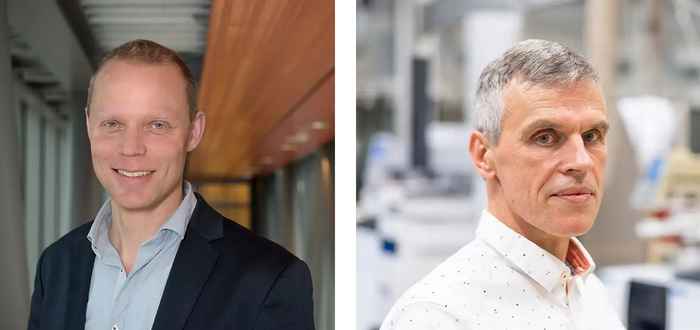
How did this major originate?
Sape: “The idea has been around for quite some time. Elsewhere in the Netherlands there are already successful Molecular Life Sciences programmes, and we noticed that Amsterdam lacked such a variant between biology and chemistry. About two years ago we decided to seriously explore the possibilities, and together with colleagues we developed this new track, which we are very excited about.”
What advantages does it bring students?
Rob: “Until now, Amsterdam was mainly known for ecological biology. With this major, students who are interested in both chemistry and biology finally have a clear choice here too. We hope to attract students who want to work on life sciences at the molecular level, and give them a solid academic foundation.”
How many students are expected?
Rob: “We already have five biology students who have applied, which is a great start. The deadline for chemistry students is still open, and students from Science, Technology & Innovation can also participate. That creates a good mix of backgrounds and ensures the major can definitely start in September.”
How does technology play a role?
Sape: “Technology is essential in today’s life sciences. It can mean many things: from advanced equipment and analytical tools to data processing techniques and the use of AI to deal with large data sets. Through our collaboration with Science, Technology & Innovation, students will get hands-on experience with these methods, which strengthens the programme enormously.”
What makes this major unique?
Sape: “The special feature is the close link between chemistry, biology and data science. Our ambition is to make data science a fundamental part of the curriculum, making use of Amsterdam’s strong expertise in AI and computer science.”
Rob: “Students move from molecule to cell to organism and work with a wide range of methods and techniques, from chemistry to biomedical sciences. That combination really makes it distinctive within the UvA.”
What will students gain on the job market?
Sape: “Graduates will be able to understand both the language of biology and the molecular perspective of chemistry. That combination is becoming increasingly important in research.”
Rob: “And with bioinformatics skills as well, they will be true all-rounders – fluent in biology, chemistry and informatics. That makes them highly attractive to employers in both research and industry.”
What makes you proud?
Rob: “We are proud of the cooperation between disciplines within the UvA, with SILS and HIMS, and also of the collaboration with the VU, which contributes the biochemistry courses.”
Sape: “Breaking down barriers between disciplines and offering a truly multidisciplinary education is something we are very proud of. It is an important step towards the goals of our faculty and a unique opportunity for students.”