Designing new molecules for the treatment of Parkinson's disease
8 October 2026
The number of people with Parkinson's disease has doubled over the past 30 years to more than ten million worldwide. This chronic brain disorder involves the death of nerve cells that produce dopamine in the brain. The resulting dopamine deficiency causes motor and behavioral impairments that progressively worsen.
To date, there are no medications capable of curing Parkinson's disease or slowing the progression of the condition. However, there are specific medications based on levodopa that can suppress symptoms. Levodopa is converted into dopamine within the body, thereby increasing the brain's dopamine supply. Yet, this medication also causes unpleasant side effects, primarily because levodopa reaches areas of the brain where it is not supposed to be.
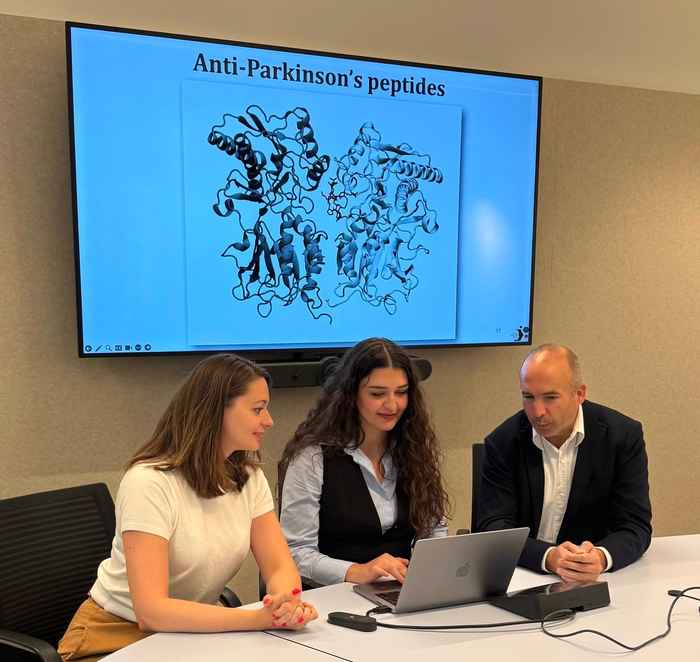
In a new research project at the UvA MMD TechHub, postdoctoral researcher Niki Paspali, Lars van der Heide (Associate Professor of Molecular Neuroscience), and Assistant Professor Ioana Ilie are collaborating to design new molecules for treating Parkinson’s disease. Prof. Dorus Gadella and Peter Coveney will also join the project at a later stage. Their goal is to target the dying cells in Parkinson’s patients, prompting them to produce more dopamine or preventing them from dying off.
On-off switch
Parkinson’s symptoms only become apparent once a person has lost approximately 80% of their dopamine production. This means that dopamine-producing cells still remain at that stage. Van der Heide: 'If you can get those cells to work a little harder, Parkinson’s patients could potentially be symptom-free, at least temporarily.'
In previous research, the scientists discovered that activating a specific receptor, Gucy2c, within the cells leads to increased dopamine production. Van der Heide notes: 'The molecule we currently use to activate that receptor isn't ideal and cannot be administered to patients. We therefore want to design new molecules that activate this receptor and are suitable for use as medication.'
Computer simulations and AI
To identify a new molecule suitable as a Parkinson’s drug, the scientists are using computer simulations and AI. Within the project, Assistant Professor of Computational Chemistry Ioana Ilie and postdoctoral researcher Niki Paspali are collaborating to design these new molecules. They combine rational design based on known structural information and binding motifs with generative AI and molecular dynamics simulations.
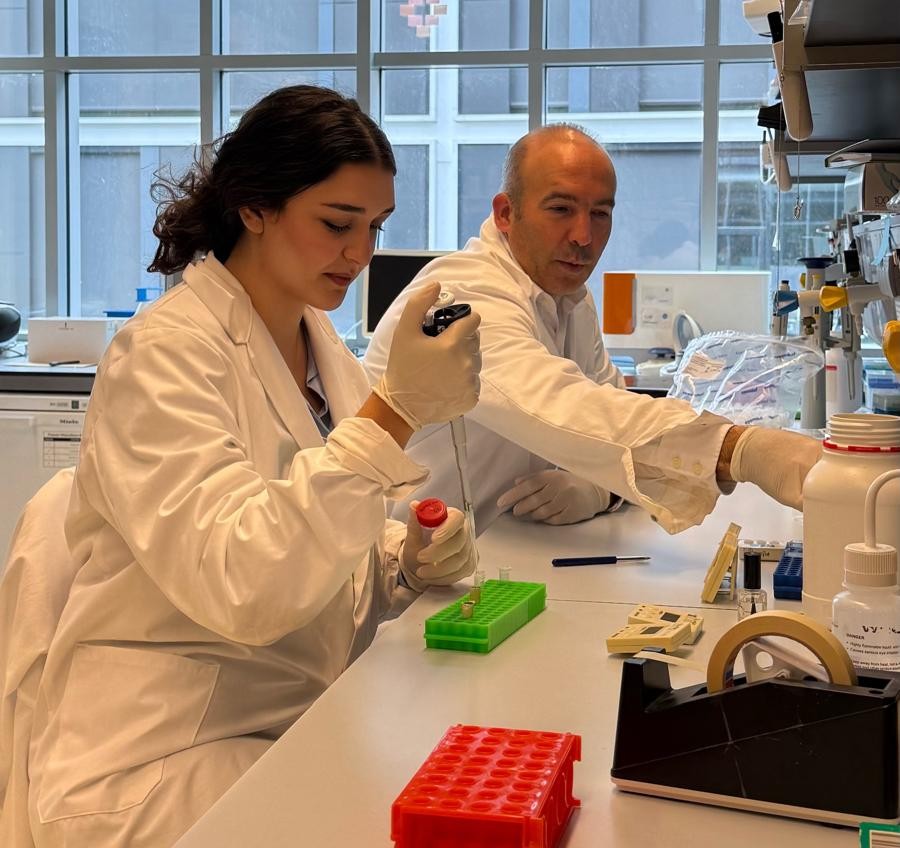
This allows promising candidates to be further screened for factors such as stability and behavior in a biological environment. Van der Heide: ‘Initially, we primarily look for a molecule that is highly active and binds best to the receptor, as this results in longer receptor activation. Once we have a number of good candidates, we synthesize and test these molecules in the lab.’
Based on the lab results, the scientists can then modify the molecules and improve them step by step. Ultimately, this leaves a few promising molecules that can be further developed into a medication for future Parkinson’s patients.
Slowing down cell death
In addition to alleviating Parkinson’s symptoms, the increased dopamine production appears to slow down the death of the cells themselves. Van der Heide notes: ‘If this holds true, it could become a revolutionary new way to treat Parkinson’s disease.’ An added benefit is that only the cells that normally produce dopamine are activated, potentially avoiding the side effects associated with levodopa.
New approach
This MMD project demonstrates a unique new approach to developing drugs for brain diseases. According to Van der Heide, the project’s strength lies in the collaboration between scientists with diverse areas of expertise. This enables researchers not only to design new molecules but also to test them immediately in the lab. Van der Heide observes: ‘The AI revolution is making this type of collaboration more common, but in my view, it should happen even more frequently.’
The scientists are currently exploring ways to expand their existing collaboration and continue the project beyond the term of the MMD funding. They also aim to apply this unique research model to other projects, not just for Parkinson’s disease, but potentially for conditions such as Alzheimer’s or ALS. Van der Heide adds: ‘There are all kinds of projects we could set up in a similar way. In that respect, this collaboration is extremely promising.’